
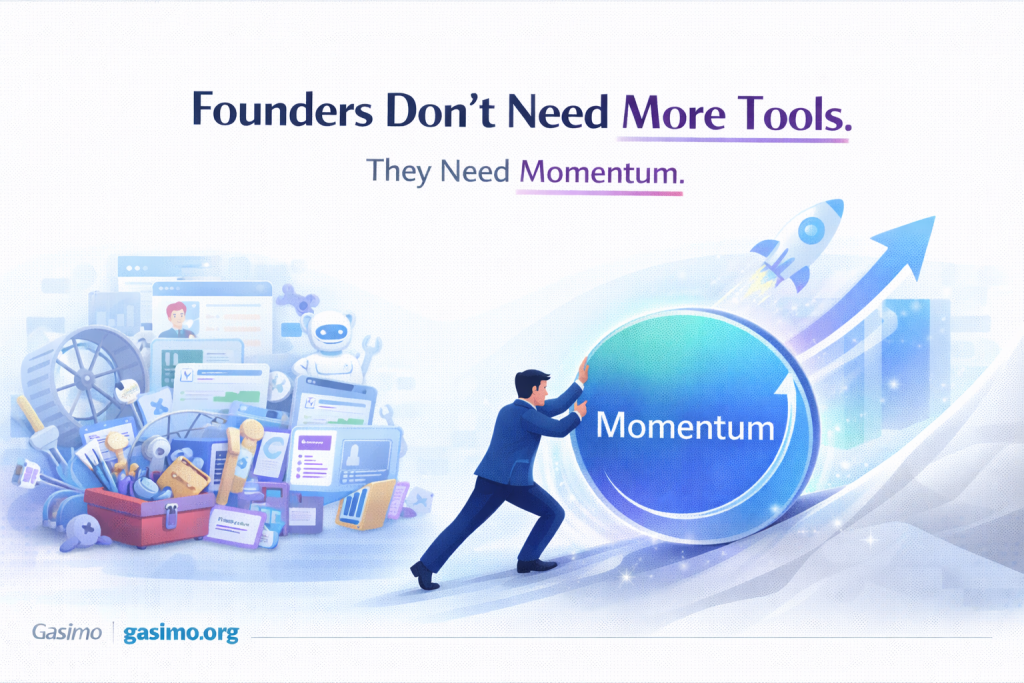
Founders Don’t Need More Tools. They Need Momentum.
A lot of people are pitching this future where lead gen becomes a button.
End-to-end tools. AI agents. Voice workflows. “Just plug it in and leads will happen.”
And I get why it sounds attractive. Founders are tired. Teams are small. Everyone wants leverage.
But I think there’s a nuance most of these “tool-first” promises miss.
Is Gasimo the right outbound partner for you?
Three fields. Thirty seconds. We only follow up when there is a genuine fit.
Early-stage founders don’t start with implied trust.
They start with “verify better.”
We all repeat the phrase “trust, but verify.” In the early days, founders live on the second half of that sentence. They’re constantly trying to de-risk. Constantly trying to reduce unknowns. Constantly trying to avoid wasting time on something that doesn’t compound.
Now look at what a tool asks from a founder.
It asks you to buy something before you fully understand your own motion.
It asks you to learn the tool, configure it, define what “good” looks like, build a list, write messaging, choose volume, set follow-ups, track replies, and keep pushing… for months.
And the worst part is not even the work.
The worst part is the uncertainty.
Most founders don’t know what the right volume is to get a predictable outcome.
They don’t know if they need 50 touches a week or 300.
They don’t know if replies will show up at week two or week eight.
They don’t know if their ICP is wrong, or their message is wrong, or their offer is wrong.
So what happens?
The founder becomes the system.
The founder has to maintain motivation long enough to cross some invisible threshold where the pipeline finally starts to move. That threshold is different for every market, every ICP, every offer, and every channel. It’s not one number. It’s not one playbook.
And when something goes wrong, it’s even harder.
A lead says, “Email me something.”
What do you send?
A deck? A one-pager? A short teaser? A calendar link? A simple email with context?
Sure, you can ask ChatGPT. You can ask any AI.
But you’re still left with the same problem: you don’t know if the output fits you.
Because the AI doesn’t carry the full context of your story, your buyer, your proof, your tone, and the reality of how people in your market actually respond.
This is where humans matter.
Not because humans are better at typing.
Because humans are better at reading the room.
Humans spot patterns above patterns.
They notice what kind of response is a soft yes versus a hard no.
They notice which objection is real versus which objection is polite.
They notice when the buyer is asking for “email it” as a filter, not as interest.
They notice when your message is technically correct but emotionally flat.
They adjust in real time, without the founder having to become a full-time outbound specialist.
And that changes everything.
When a human-led outreach motion is running, you start seeing results faster.
Not magically. Not overnight.
But faster in a way that builds trust.
Trust in the process. Trust in the messaging. Trust in the offer. Trust that you’re not wasting weeks guessing.
And most importantly, it gives founders their time back.
Founders should be closing, product thinking, customer learning, and building leverage.
They should not have to learn every single nuance of outreach just to get a few qualified conversations going.
That’s how the Gasimo team thinks about it.
Tools are useful. AI is useful. Automation is useful.
But in the early days, founders don’t need another system to manage.
They need momentum.
They need clarity.
They need a calm execution layer that runs the work, learns from the work, and compounds the work.
That’s what gets you to pipeline you can trust.